

Key Takeaways
Banks may offer education loans for Online MBA programs, provided the university and course meet their eligibility criteria.
An MBA education loan can cover tuition fees, examination fees, and other eligible expenses. Compare interest rates, repayment tenure, and EMIs before applying.
Students can also consider semester-wise fee payments, no-cost EMI, scholarships, or employer-sponsored fees to manage their Online MBA expenses.
This guide covers the eligibility criteria for education loans for Online MBA programs, the application process, required documents, expenses covered, interest rates, and repayment options. It also compares education loans with EMI options and highlights the financing options available at ATLAS SkillTech University.
Is an Education Loan Available for an Online MBA in India?
Yes, the banks/financial institutions can sanction loans for Online MBA and Distance MBA courses in India. But the eligibility criteria for granting the loan would depend on the lender's policies, recognition of the university, and the course itself.
Unlike traditional MBA courses, not all Online MBA courses are eligible for the loan. There are certain conditions set by the banks for sanctioning the loan for Online and Distance courses
You can also read our guide on Is an Online MBA Equivalent to a Regular MBA? to understand the key differences between online and regular MBA programs in terms of recognition, learning experience, and career opportunities.
Can Banks Provide Loans for Online and Distance MBA Programs?
Yes, there are some banks that consider Online MBA applications, as long as the program and college satisfy their criteria.
For instance, the education loan criteria of Indian Bank include some executive management programs and MBA programs conducted on a part-time or distance mode for working professionals, based on criteria like completion of degree and work experience. Indian Bank Nevertheless, there is no guarantee of the loan being approved. It would be wise to find out from the bank if your Online MBA program is eligible or not.
You can also read our guide on Is an Online MBA Valid Abroad? to understand the recognition and acceptance of online MBA degrees internationally.
Do Banks Have Specific Requirements for Online Universities?
Yes. Banks may check the following details before approving an education loan for MBA:
UGC Recognition: The college should have recognition or entitlement from the UGC to conduct the Online MBA program for that particular academic year.
Course Approval: The specific MBA course needs to be approved as per the UGC-DEB guidelines.
Admission Letter: Banks may request an admission letter and fee structure.
Reputation and Credibility: Banks might take into account the reputation of the institution as well as the course.
Eligibility Criteria of the Applicant: The applicant might satisfy all eligibility criteria required by the bank.
How to Get an Education Loan for an MBA in India?
There are certain key processes to get an education loan for MBA in India. Banks and other financial institutions provide education loans to eligible candidates to meet the educational expenses, which include tuition fees. Below are some processes that will guide you in applying for an MBA education loan.
Step 1: Get Admission to an MBA Program
First, get accepted into a recognized university or business school where an MBA course is offered. Banks usually need an admission letter to process your loan application. Have the admission letter and the fee structure available.
Step 2: Check Your Loan Eligibility
Review the eligibility conditions stipulated by the bank before you apply. Even though different lending institutions have different conditions, the standard ones include:
Nationality: The applicant ought to be an Indian citizen.
Educational qualification: A valid bachelor’s degree and admission into a qualifying MBA program.
Co-applicant: A parent, guardian or spouse may be necessary as a co-applicant.
Financial background: The institution may want to consider the income and credit status of the co-applicant.
Step 3: Compare Different Education Loan Options
Do research on and compare education loans available from various banks and financial institutions. While choosing a lender consider the following considerations:
Interest rates and fees.
Highest amount of loan.
Collateral or guarantee required.
Repayment period of the loan.
Moratorium period.
Charges for processing and other.
Expenses covered by the loan.
The list of various banks which provide education loans includes SBI, Bank of Baroda, Punjab National Bank, HDFC Bank, and ICICI Bank.
Step 4: Arrange the Required Documents
Once you select a lender, arrange the documents required for the application. These generally include:
The bank may ask for additional documents depending on your loan amount and financial profile.
Step 5: Apply for the Education Loan
Your education loan application can be made online via the bank’s official website or at the nearest branch. You can also check out the various education loans you qualify for via the PM-Vidyalaxmi portal. Fill out the application form correctly and attach all the necessary documents. Ensure that all the details are correct.
Step 6: Complete the Verification Process
After you submit your application, the bank will check your admission details, academic details, documents, and financial background. The bank may even assess the repayment capacity of the co-applicant and see if any collateral or guarantor is needed.
If your application fulfills all the conditions set by the bank, then the bank will sanction the loan to you and give you a sanction letter.
Step 7: Receive the Loan Amount
Once all the conditions of the loan have been accepted and the formalities are complete, the bank will disburse the amount of money approved. In most cases, the loan amount is sent to the university or institution as per their fee-paying arrangement. Other expenses that may qualify under the agreement will also be settled.
Also Read: Who Should Choose an MBA in Marketing? A Career-First Guide
What Expenses Does an MBA Education Loan Cover?
However, an MBA education loan need not only pay for tuition fees. It could be utilized to pay for the exam fees, hostel fees, book costs, etc., as required by the program. Following are the most common cost heads financed by an MBA education loan.
Tuition Fees and Examination Fees
Most MBA education loans will take care of the fees that are charged by the university or the business school. These can be semester fees, admission fees, and exam fees. The total amount borrowed is usually paid directly to the institution as per its fee structure.
Hostel and Living Expenses
Other education loans may even provide for hostel accommodation and any other reasonable living expenses that one may incur during the course of the MBA program. These can be:
Fees for hostel or accommodation.
Fees for food and mess, where applicable.
Books, study materials and other academic resources.
Laptop or computer expenses, if allowed by the lender.
Travel expenses related to studying, subject to the loan terms.
Note: The expenses covered and the maximum amount allowed may vary between lenders. Always check the bank's loan policy and eligible expense list before applying.
Also Read: Is Online MBA Degree Valid in India?
MBA Education Loan Interest Rates
The interest rate for MBA educational loans differs from one bank to another. This depends on various factors like the loan amount, educational institution, financial standing of the loan applicant, credit record of the co-applicant and the presence or absence of collateral.
Most banks give floating interest rates while some lenders give fixed interest rates. Compare interest rates of different banks before taking out a loan.
MBA Education Loan Interest Rates Offered by Different Banks
Here is an indicative comparison of education loan interest rates offered by some major banks in India.
(Sources: Official bank rate pages)
Factors That Affect MBA Education Loan Interest Rates
College ranking: Students enrolled at top schools could be eligible for favorable interest rates.
Loan amount: The amount of money borrowed, and the type of loan could influence the interest rate.
Collateral: Secured loans could have lower interest rates than unsecured loans.
Credit history: The credit score of the co-applicant could influence the interest rate offered by the lender.
Repayment tenure: The selected repayment period could influence the total interest charged.
Note: These are indicative starting or scheme-specific rates, not guaranteed offers. Actual rates depend on the lender's current policy and your eligibility. Check the official bank website before applying, as interest rates can change.
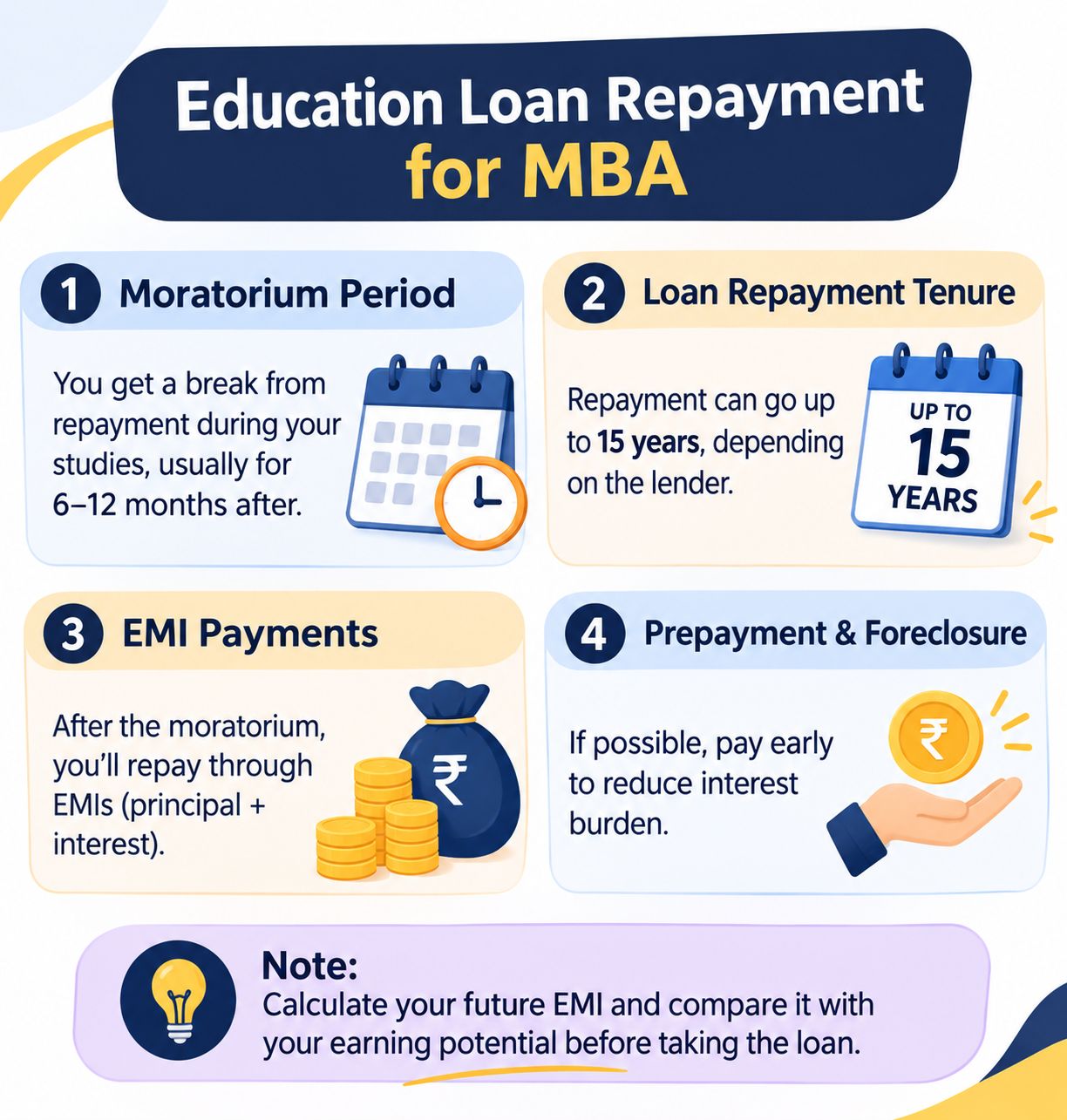
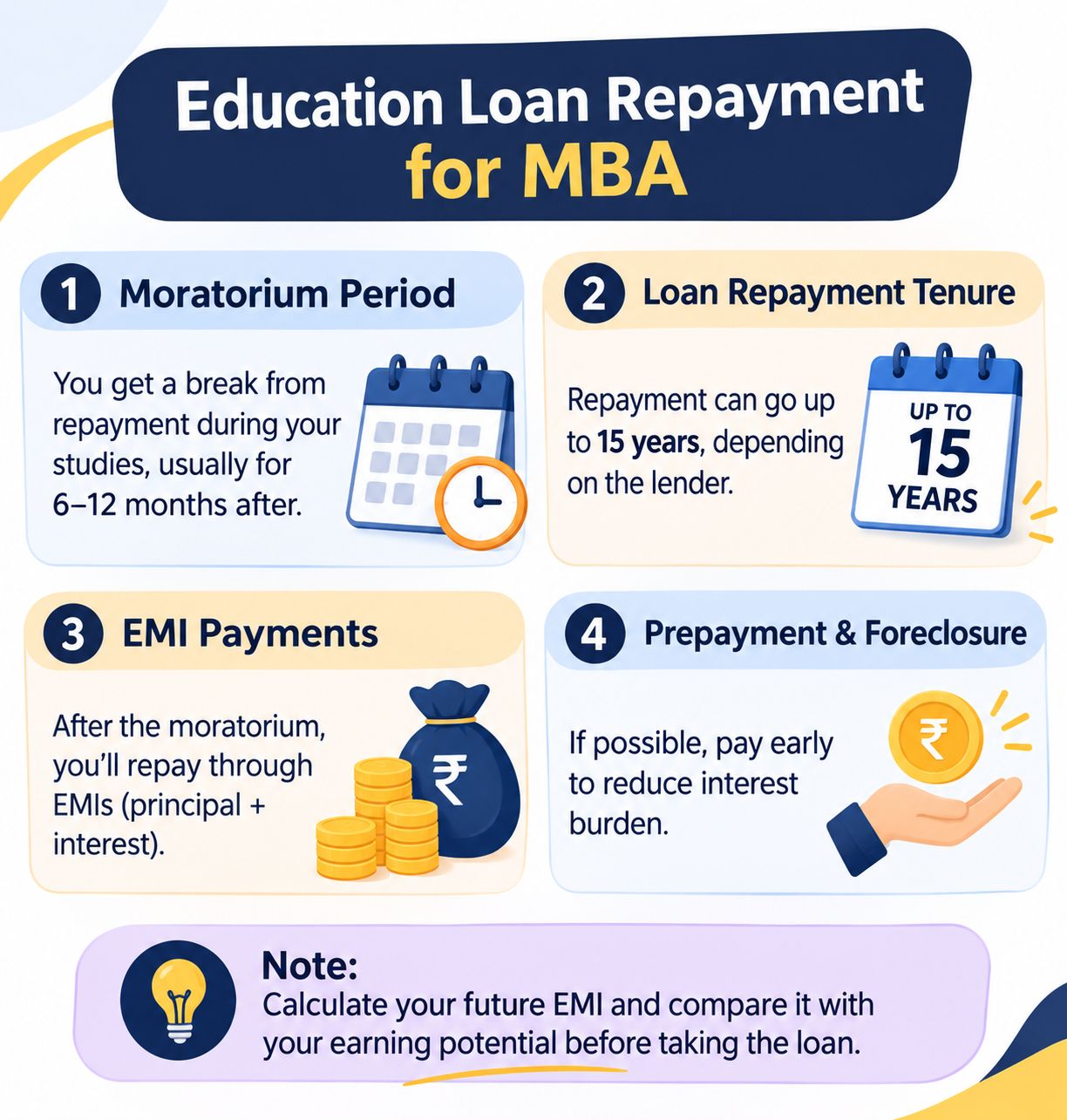
Education Loan Repayment for MBA
The process of repaying an education loan for the MBA degree normally starts after the completion of the course or after the moratorium period comes to an end. Most banks offer a repayment holiday during the period of the course as well as after the course completion. Here are some important aspects of MBA education loan repayment: