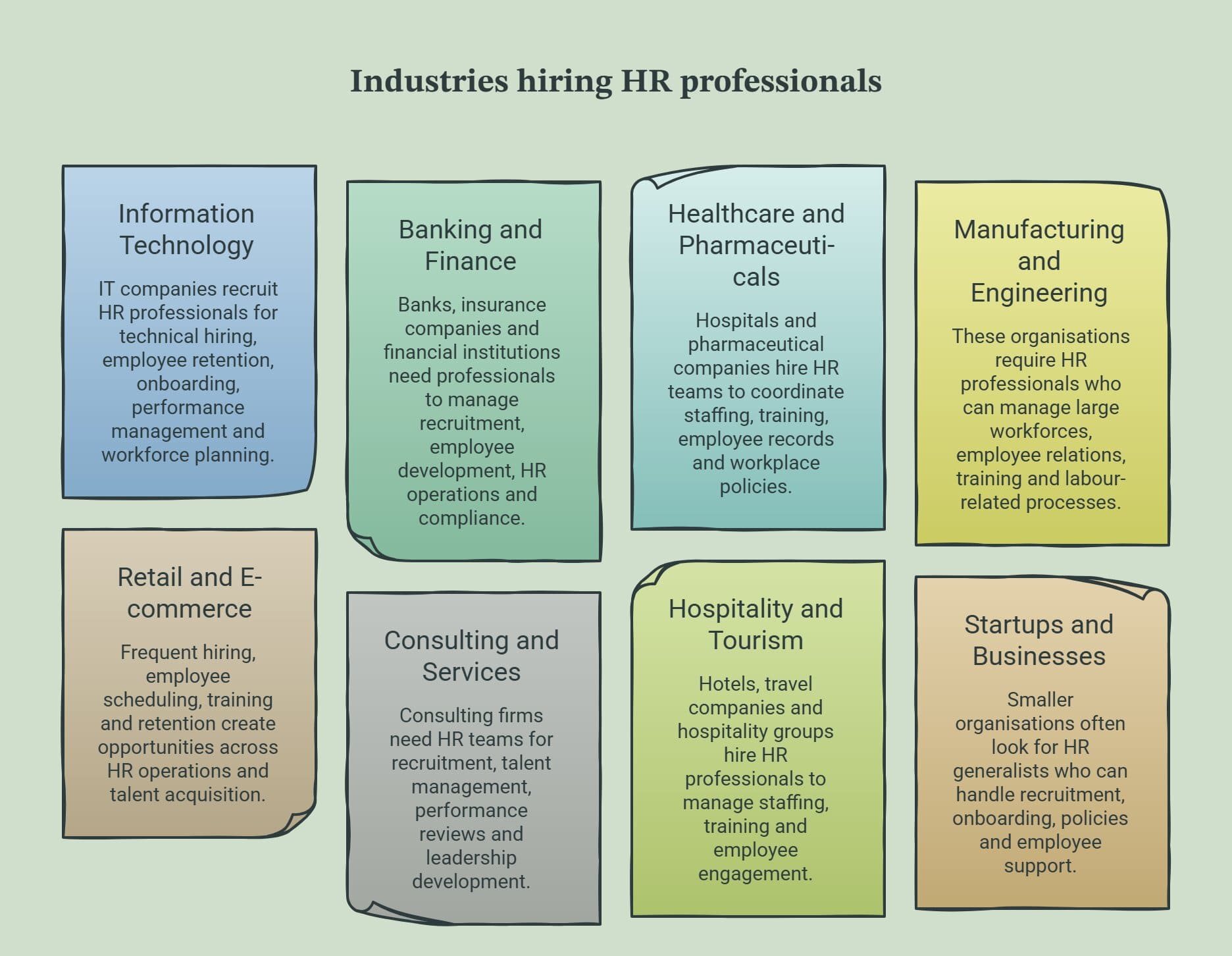
Your choice of industry can shape the kind of HR experience you gain. A role in a large organisation may involve working within a specialised HR team, while a startup may give you exposure to several HR functions at once.
How Does an HR Career Progress from Entry-Level to Senior Positions?
Most HR professionals begin by supporting day-to-day activities such as recruitment coordination, employee documentation, onboarding and HR operations. As they gain experience, they may take ownership of specific functions, manage teams and contribute to wider business decisions.
There is no single route to senior HR positions. Someone working in recruitment may grow into a talent acquisition leadership role, while an HR generalist may move towards HR management or business partnering.
A typical career progression may look like this:
Career Stage (with average salaries) | Possible Job Roles | Key Responsibilities |
Entry Level (INR 2.6-4.2 LPA) | HR Trainee, HR Executive, Recruitment Associate | Supporting recruitment, onboarding, employee records and routine HR activities. |
Early Career (INR 5.3-5.6 LPA) | Senior HR Executive, HR Generalist, Talent Acquisition Specialist | Handling HR processes independently, coordinating hiring and resolving routine employee concerns. |
Mid-Level (INR 11.4-14 LPA) | HR Manager, L&D Manager, Talent Acquisition Manager, HR Business Partner | Managing HR functions, leading teams, planning workforce requirements and advising department heads. |
Senior Level (INR 20-36.4 LPA) | Senior HR Manager, Senior HR Business Partner, Head of Talent Acquisition | Leading larger teams, managing HR budgets and shaping policies and talent strategies. |
Leadership Level (INR 51.2-68.7 LPA) | HR Director, Vice President of HR, Chief Human Resources Officer | Setting the organisation's people strategy and contributing to major business decisions. |
Source: AmbitionBox
The time taken to move between these stages varies. It depends on the organisation, individual performance, the complexity of the role and the opportunities available within the company.
Specialisation can also influence progression. An HR professional with strong experience in compensation, people analytics or organisational development may move into senior specialist or leadership positions without following the generalist route.
Which Skills Can Help You Grow After an MBA in HR?
Knowing HR concepts is a starting point, but the work also calls for sound judgement, clear communication and the ability to handle situations involving people. A hiring decision, a workplace disagreement or a performance discussion may require a different approach each time.
The skills that support a career after MBA in HR include:
Communication: HR professionals interact with candidates, employees, managers and senior leaders. Clear communication helps them explain policies, conduct interviews and handle sensitive conversations.
Conflict Resolution: Workplace disagreements are common. The ability to listen, understand different viewpoints and work towards a fair solution is useful across HR roles.
Data Analysis: HR teams use employee data to study hiring trends, attrition, attendance, performance and workforce requirements.
Knowledge of Employment Laws: Understanding labour laws, workplace policies and statutory requirements helps HR professionals manage compliance-related responsibilities.
Recruitment and Interviewing: Candidate sourcing, interview coordination, assessment and negotiation are important for people working in talent acquisition.
HR Technology: Familiarity with Human Resource Management Systems (HRMS), applicant tracking systems and payroll software can make routine HR work more organised.
Business Understanding: HR decisions affect costs, productivity and team performance. Understanding how an organisation works helps professionals make practical recommendations.
Leadership and Decision-Making: As responsibilities increase, HR professionals need to guide teams, manage difficult situations and take decisions that affect the wider workforce.
You do not need to master every skill before starting your first job. It is more useful to build a strong foundation and develop specialised skills as you understand which part of HR interests you most.
Explore Career Opportunities After an MBA in HRPlanning to build a career in human resource management? Explore the career opportunities after Online MBA in HR and understand the roles, skills and growth paths available across different industries. What should you consider? Job Roles: Explore opportunities in talent acquisition, HR management, employee relations, HR analytics and learning and development. Industry Options: Understand how IT, banking, healthcare, manufacturing and other sectors hire HR professionals. Career Growth: Learn about career progression from entry-level HR positions to senior management roles. Essential Skills: Identify the communication, analytical, leadership and technical skills valued in HR.
Ready to take the next step? Explore the Online MBA at ATLAS SkillTech University, understand its curriculum and learning approach, and see how it aligns with your management career goals. |
What Factors Influence Career Growth After an MBA in HR?
Two graduates with the same qualification may have very different career journeys. One may move into a specialised role early, while another may spend more time building experience across HR operations. Several factors influence how quickly responsibilities and opportunities grow.
Relevant Work Experience: Internships, live projects and prior work experience can help graduates understand how HR teams operate. Practical exposure also gives them examples to discuss during interviews.
Choice of Specialisation: Experience in areas such as talent acquisition, compensation, HR analytics or learning and development can shape the roles available later.
Industry Knowledge: Understanding the workforce requirements and business environment of an industry can make an HR professional more effective in that sector.
Organisation Size and Structure: Large companies may have separate teams for recruitment, payroll, employee relations and learning. Smaller businesses may expect one HR professional to handle several functions.
Professional Development: Short courses and certifications in areas such as HR analytics, labour law, talent management or HR technology can add to existing knowledge.
Performance at Work: Consistent work, sound judgement, employee handling and the ability to manage responsibilities can influence promotions and leadership opportunities.
Networking and Professional Relationships: Working with colleagues across departments and building professional connections can help HR professionals understand different business functions and identify new opportunities.
Why Choose ATLAS SkillTech University Online MBA in HR?
An MBA helps students develop business, management and decision-making skills. This knowledge can be useful in HR roles involving workforce planning, employee management and coordination with department heads.
ATLAS SkillTech University's Online MBA follows an AI-focused, industry-oriented learning approach and covers different areas of business management. However, it is a general corporate MBA rather than a dedicated MBA in Human Resource Management.
Some features of the program include:
87-Credit Curriculum: The program covers business and management subjects across areas such as finance, marketing, entrepreneurship and decision-making.
AI-Focused Learning: Students are introduced to AI tools and practical applications as part of their learning experience.
Industry Exposure: The learning approach includes interaction with faculty members, industry experts, founders and professionals.
Flexible Learning Format: The online format offers flexibility for learners balancing education with work or other responsibilities.
Business Skills: The program focuses on areas such as communication, strategic thinking, analytics, problem-solving and stakeholder management.
Conclusion
An MBA in HR opens up career opportunities in recruitment, employee development, workplace relations, HR analytics and management. The right role depends on your interests and the skills you want to develop.
You can begin with an operational HR position and move into specialised or leadership roles as you gain experience and take on greater responsibilities.