

Key Highlights
To become a product manager after an online MBA, you need more than the degree. Add basic tech knowledge, real proof of work and a clear plan. A coding background is not required, and a realistic planning range is about 6 to 12 months.
Product management is responsible for defining the purpose of a product, its target audience and the value proposition. Basic technical understanding, basic data analysis skills and a good working relationship with engineers are sufficient for the job.
An online MBA will teach you the basics of business and strategy, but through projects and case studies, you will be able to demonstrate your ability to implement this. Choose a path that suits you, whether it is internal transition, a transitional position, a product manager program or a start-up.
Update your CV and LinkedIn, prepare for interviews and continue to learn. Neither an online nor any other kind of course or degree can give you a guaranteed product manager position.
This blog post tells you about the role of a product manager and the technical skills required. It describes how an online MBA degree could help and what paths would work for people without a technical background, and how you can gain relevant experience even without the PM title. You will also get a 6 - 12 months roadmap, interview tips, career paths and how the ATLAS Online MBA could assist you.
How to Become a Product Manager After an Online MBA: Quick Answer
An online MBA course can help you switch careers to product management, but that will not be enough on its own. To learn how to become a product manager in India, you will need some technical knowledge, work experience and a plan. This is a brief description.
Get to know the role: Understand what the responsibilities of a product manager are.
Fill the technical gaps: Acquire technical terminology, basic data and technology skills.
Choose your path: Choose the way you will get there, whether internally, through another role first, from a PM programme or from a startup.
Prove yourself: Work on case studies or take responsibility of a project.
Prepare for the interview: Refresh your CV and practice the PM interviews.
Reposition and interview: Update your resume and practise PM interview questions.
Moving into product management from marketing, finance, HR, operations or sales is realistic, and you don’t need to be an engineer to do it.
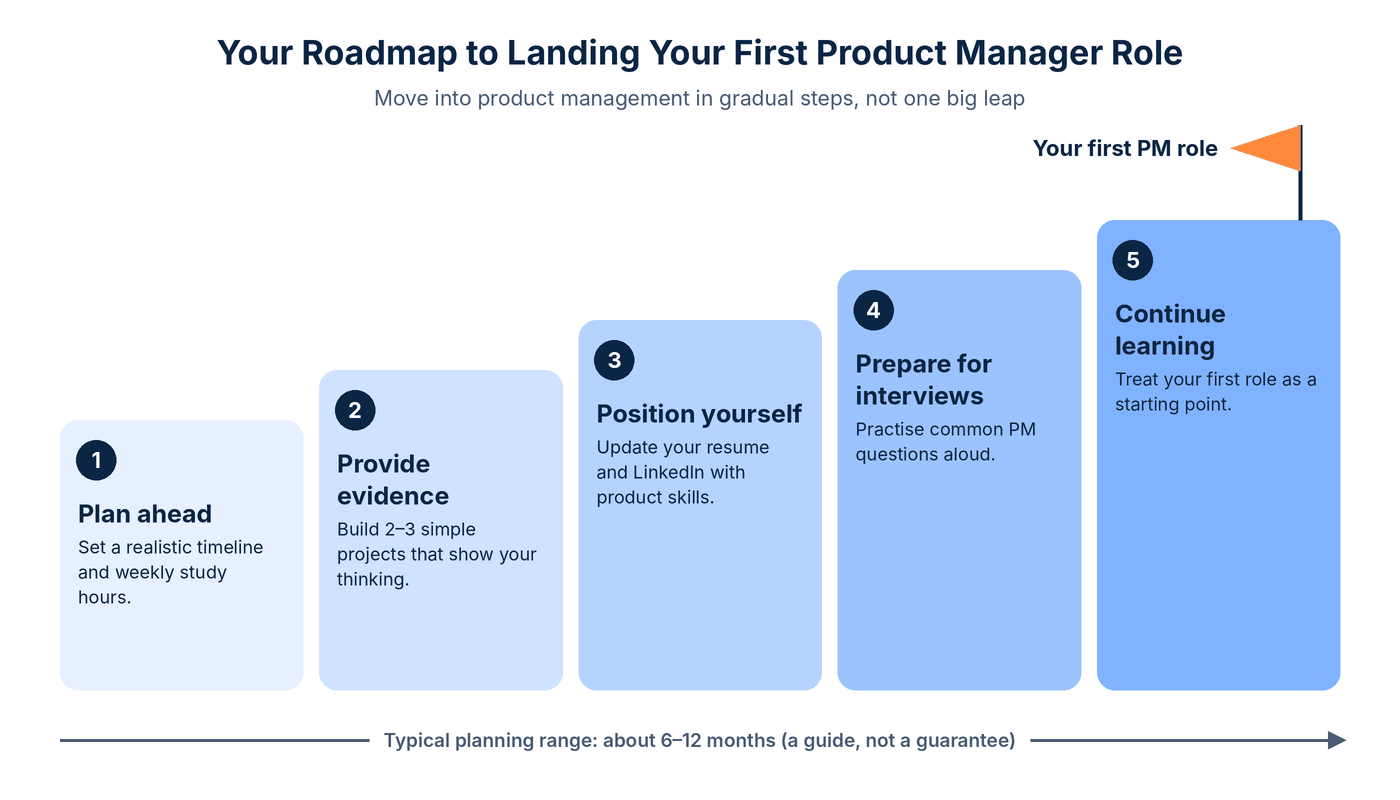
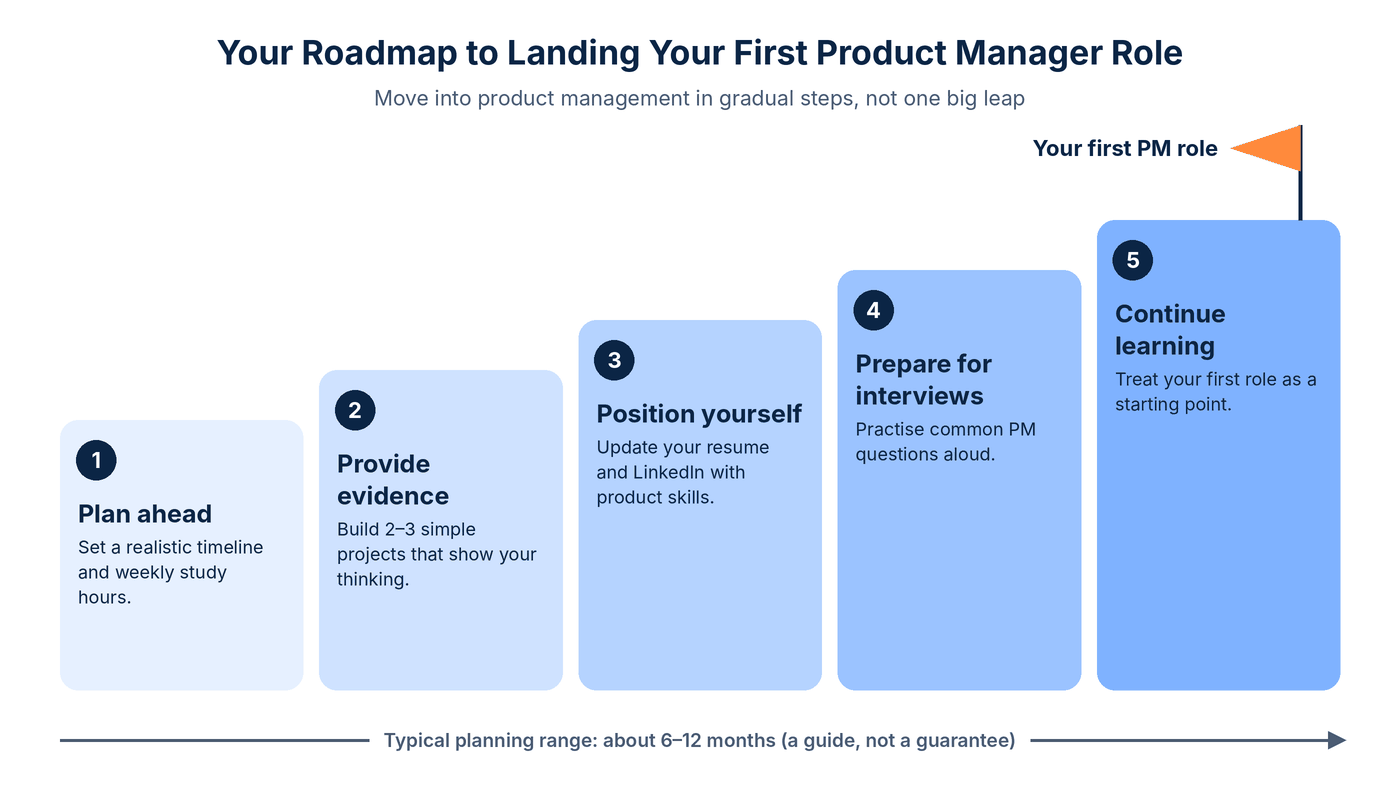
Indicative timeline: Plan for about 6 to 12 months. This is a suggested planning range, not a promise, and it changes with your experience and free time.
Who: Learners studying MBA programs from non-technical or engineering programs like marketing, finance, HR, operations or sales.
Who this is not for: Someone with a coding degree. It is expected that you understand how technical teams operate, but you don't have to write any production code.
Important disclaimer: Nothing can guarantee you a job of Product Manager. There is a high competition in the entry-level positions and your result will depend upon your skills, your evidence and your efforts.
Understanding Product Management: Roles, Responsibilities and Technical Skills
Product management is the process of making decisions on what functionality the product has, to whom it is targeted and why it is useful. The Product Manager (PM) ensures that his product goes through its development lifecycle, coordinating activities of designers and engineers so they create the right product.
Focusing on user needs: PM learns needs of users, so that the product team creates something useful and needed by real users and not something good-looking in a presentation.
Prioritization: PM decides which things are urgent and which are less important since no team can do everything at once.
Team alignment: PMs unite engineers, designers, sales, and management into a team that works towards the same goal.
Measuring results: PMs measure metrics like number of sign-ups or daily users to see whether the product really delivers value to the customer and the company.
What does a Product Manager actually do?
Consider the example of the food delivery application with user feedback that order placement takes too much time. PM identifies the source of the problem and prioritizes payment screen improvements. Engineers create a solution, and PM makes sure that the order placement time has decreased.
This is an example of what a PM does on a daily basis. They knows the user, defines priorities, owns the roadmap, aligns the team, and measures results.
These roles can overlap, and some companies use the titles differently. Always read the job description, not just the title.
Wondering how to become a good product manager? Start by asking yourself these questions:
Do I stay calm when answers are unclear?
Can I influence people even when I am not their boss?
Am I comfortable saying no to good ideas so the best ones get done?
Do I enjoy talking to users and colleagues often?
Do I like using data to back up my decisions?
Can I explain a complex idea in simple words?
This is a simple self-check, not a scientific test. If most answers feel like a yes, the role may suit you.
Do you need a technical background to become a Product Manager?
Usually, no. Most PM roles do not need a coding degree. But basic tech knowledge helps you work well with engineering and data teams. Aim to know at least these basics:
Software basics: How an app is built, tested and released to users.
APIs, in simple terms: A way for two apps to talk to each other, like a waiter carrying orders between you and the kitchen.
Agile and Scrum: Working in short cycles, with regular check-ins and updates.
Analytics dashboards: Reading charts that show how people use a product.
Basic SQL or spreadsheets: Pulling and checking simple data on your own.
Working with engineers: Asking clear questions and respecting their time.
At entry level, you can usually skip writing production code and designing deep system architecture. The depth you need varies. Consumer apps ask for less, while platform and AI products may ask for more, so check each job post.
How an Online MBA Can Help You Transition into Product Management
With an online MBA, you receive knowledge about business, the degree and organized education. With an online MBA, you do not receive experience with products right away. The following paragraphs show you what MBA can provide, the routes that are feasible for nontechnical candidates and what you should develop before applying.
Business context: Knowledge in marketing, finance, and strategy allows you to understand the role of the product within the company from its business perspective.
Decision skills: MBA courses teach you how to analyze the alternatives and justify your decision, which is what PMs do on a daily basis.
Gaps to fill: An MBA does not necessarily mean that you have a shipped product experience and technical knowledge. You should develop these skills purposefully.
Evidence matters: Evidence of projects and achievements is necessary. With an online MBA, you might need to be more active in building connections.
How does an Online MBA prepare you for PM roles?
Each row ends with something you can actually do and show. A degree says you studied. A project says you can apply it.
An MBA also does not promise a hiring pipeline or equal acceptance by every employer, and views on online degrees can vary. Your specialisation, such as marketing, analytics, finance or operations, can shape which PM roles suit you best.