


Quick Overview:
An MBA in Finance and HR offers career opportunities in finance, human resource management, and combined roles such as HR Financial Analyst and Compensation Manager.
Graduates can work in industries like banking, IT, consulting, healthcare, manufacturing, and e-commerce, with salaries depending on experience, skills, and job roles.
The dual specialisation helps develop financial planning, budgeting, recruitment, HR analytics, communication, and leadership skills for long-term career growth.
What Career Opportunities Are Available After an MBA in Finance and HR?
The Online MBA in Finance & Human Resources will give you the ability to choose a career in either field. You may pursue a career in finance, recruitment, personnel management, payroll or even in leadership positions with experience. Here are some of the career opportunities open to you.
Finance and HR Roles You Can Explore
If you would like to pursue your career in either finance or HR, here are a number of positions that you can take up following your Online MBA.
Financial Analyst: You will be responsible for analysing the finances of a company and providing assistance to the business in decision-making related to finances.
HR Manager: You will deal with all the aspects related to Human Resources and recruitment of employees.
Financial Planner: You will assist in planning the finance-related operations of an organization.
Talent Acquisition Manager: You will take care of the recruitment and hiring process of an organization.
Compensation and Benefits Manager: You will be responsible for managing the compensation and benefits of the employees.
Payroll Manager: You will manage the payroll of the employees.
Hybrid Roles That Combine Finance and Human Resource Management
If you have an interest in both finance and HR, you may also consider jobs that combine the two. These jobs will let you handle employee-related decisions while taking care of business budgets.
HR Finance Manager: You will handle HR budgets, track employee expenses and budget for workforce costs.
Compensation and Benefits Analyst: You will conduct analyses related to salaries and help develop a compensation system for organizations' employees.
HR Business Partner: You will collaborate with the management teams so that you can align employees' needs with business objectives.
Workforce Planning Manager: You will assist in planning for staffing requirements for companies and managing workforce costs.
People Analytics Manager: You will analyse data relating to the workforce in order to identify workforce trends.
Management and Leadership Opportunities
As your experience builds, you can take up more senior roles where you would be handling managerial duties as well as decision-making and organisational strategies. These are some roles that you can aspire to:
Finance Manager: You will be responsible for managing budgets, financial statements, and financial planning of the firm.
Human Resources Director: You will manage human resources teams and make decisions regarding recruitment, employee development, and work policies.
Chief Financial Officer (CFO): You will be responsible for managing the financial strategy of the firm and making financial decisions.
Chief Human Resources Officer (CHRO): You will be responsible for managing the human resources strategy of the firm and workforce development.
Business Operations Manager: You will be responsible for managing business operations of the firm.
Which Careers Require Both Finance and HR Skills?
what if you love dealing with numbers and also have an interest in managing people? In fact, you can even do both at the same time because there are jobs where both are needed. Here are some jobs that combine finance and HR and in which you deal with salaries, benefits, budgeting of labor, and hiring.
How Does an MBA in Finance and HR Prepare You for These Careers?
MBA in Finance and HR will give you knowledge about two very critical aspects of business management, which include financial management and human resource management. You will be taught how to create budgets, recruit staff, handle salaries, and make all other relevant workforce decisions. Let us now see how the skills that you will acquire in this course will benefit you in your career.
Financial Planning and Budget Management
Any business must always have proper management of finance, and it is this very area in which your finance knowledge becomes useful to you. In this course, you will learn how to budget, manage expenses, and analyze financial reports.
Recruitment and Workforce Management
Getting the right candidate for the job is essential, but having enough people employed within a firm's means is equally significant. Using human resource studies, one may understand the process of recruiting, acquiring, employing, and managing people. This will be crucial to understand how team-building works.
Compensation and Benefits Planning
Have you ever thought about how corporations go about setting salary packages for employees? MBA in Finance and HR is the program for you. You will learn how to allocate budgets for compensation plans, handle employee benefits, and develop reward systems.
HR Analytics and Financial Decision-Making
Companies use information about their employees to make better decisions, and in this module, you will learn how to analyze such data. You can analyze recruitment costs, employee turnover, salary costs, and productivity of the workforce. When combined with your knowledge of finance, you will be able to make better decisions related to people and resources.
Also Read: How to Check if an Online University Is UGC-Entitled: A 5-Step Check
Which Industries Hire MBA Graduates in Finance and HR?
The major benefit of MBA in finance and HR is the fact that you do not have to work in just one field or sector. There is almost every company that needs professionals for managing their finance, employees, and other processes. Here are some fields from which you can choose your career path.
Banking and Financial Services: Engage in financial planning, payroll, recruiting, employee remuneration, and HR operations.
Information Technology and Software Firms: Get into work involving talent acquisition, workforce planning, HR analytics, employee management, and budgeting.
Consulting firms: Assist organizations in managing their workforce expenses, resource planning, HR process improvement, and financial decision-making.
Manufacturing Industry: Take care of employee salaries, labor expenses, workforce planning, payroll, and budgeting of operations.
Retail and E-commerce: Engage in recruiting, employee management, payroll, compensation planning, and financial operations.
Healthcare and Hospitals: Take care of staff recruiting, workforce budgeting, payroll, employee benefits, and HR operations.
Education and E-Learning: Discover your scope in HR management, finance management, payroll, recruitment, and training & development of employees.
Hospitality & Tourism Industry: Deal with employee management, payroll planning, recruitment, and expenses.
Pharmaceuticals: Get into the field of HR management, finance planning, workforce management, payroll, and compensation management.
Corporate organizations & MNCs: Discover your scope in finance management & HR management, business operations, etc.
Also Read: Can You Get an Education Loan for an Online MBA in India?
What Skills Do You Need for a Career in Finance and HR?
In order to develop a career in Finance and HR, one must learn to work with numbers and people at the same time. In addition to your subject expertise, some other skills will come in handy when dealing with workplace tasks and making decisions in the future. The following six skills should be developed:
Financial Analysis: Be familiar with financial statements, budgeting, costs, and analysis of business operations.
Budgeting and Financial Planning: Know how to budget, employee cost planning, and financial management.
Talent Acquisition and Management: Acquire skills for recruiting right candidates and employee development.
Communication: Have good interpersonal relationships with all employees, management staff, and other departments.
Problem Solving and Critical Thinking: Analyze and interpret employee, financial information and problems.
Leadership and Team Building: Be able to lead the team and solve work issues.
What Is the Salary After an MBA in Finance and HR?
The careers available for MBA in finance and human resource are quite many. This is subject to the field you choose. Your salary will be determined by the field you choose your experience, skills, and the company you are in. With experience, you can advance to management positions in these sectors. Let's look at the salary growth across different career stages in India.
Salary for Entry-Level Finance and HR Roles
If you are starting your career after an MBA in Finance and HR, you can explore positions such as Financial Analyst, HR Executive, Payroll Executive, and HR Analyst.
Financial Analyst: Around ₹3.5–6 LPA.
HR Executive: Around ₹3.5–4 LPA.
HR Analyst: Around ₹4–7 LPA.
Payroll Executive: Around ₹2–5 LPA.
These are indicative annual salary ranges based on reported role-level salaries, not guaranteed MBA placement packages
Salary for Mid-Level Professionals
Having 5-10 years of experience, one can start working in management roles and specialised positions. Your remuneration can rise, depending on your roles in budgeting, making decisions and managing people.
Finance Manager: Around ₹9–15 LPA.
HR Manager: Around ₹9–12 LPA.
HR Business Partner: Around ₹10–15 LPA.
Compensation and Benefits Manager: Around ₹7–10 LPA.
These figures are indicative and vary by company, industry, location, and the scope of the role.
Salary for Senior-Level Management Roles
When you are at the senior level, you may choose to pursue careers as Finance Director, HR Director or at the senior management level. In such careers, one deals with bigger teams and bigger organisational budgets.
Senior Finance Manager: Around ₹15–30 LPA.
Finance Director: Around ₹23–55 LPA.
HR Director: Around ₹40–45 LPA.
Senior HR Manager: Around ₹18–21 LPA.
Senior-level salaries can be considerably higher in large companies and multinational organisations
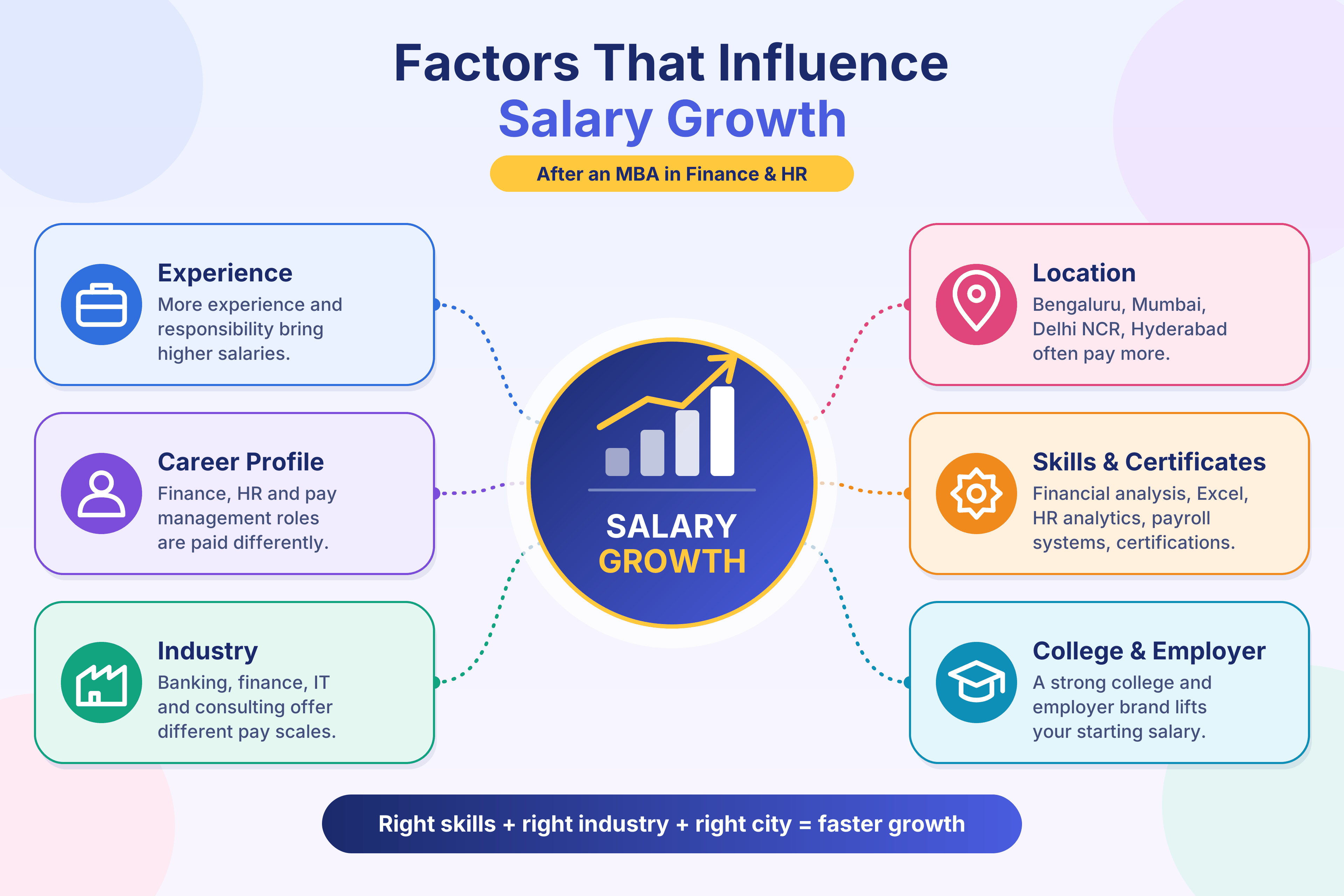
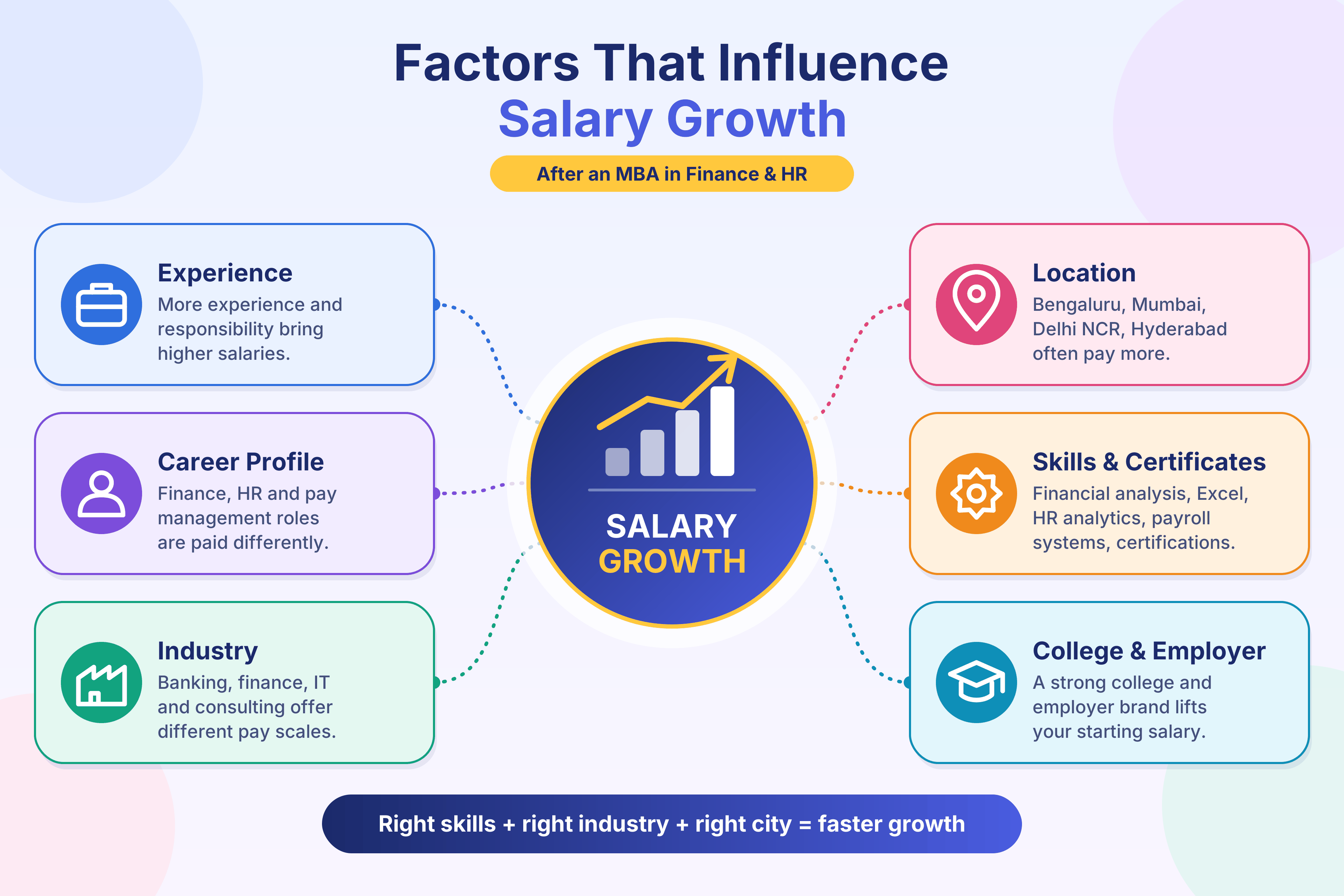
Factors That Influence Salary Growth
Your MBA degree will help you get into the finance and HR sectors, but there are a number of other aspects that affect how much money you make during your career.